Pros
- Value efficient: Steel garage doors are often budget friendly, without skimping on quality or durability.
- Insulation layers available: Insulation in steel garage doors helps with wind, temperature, and sound infiltration. Insulation can increase the energy efficiency of your garage and home.
- Low maintenance: Steel is a low maintenance material and does not require regular care, aside from a routine inspection of your garage door to ensure it’s working properly.
- Design options: There are many design options for steel garage doors, but total customization is limited.
- Durable: Steel garage doors are corrosion and fade resistant.
Cons
- Susceptible to rust and dents: Steel garage doors can rust and are easily dented so you’ll need to ensure the door is taken care of properly.
Vinyl
It’s virtually maintenance free, which means you won’t have to spend time sanding or refinishing the exterior. A simple cleaning with your garden hose is often enough to keep the door looking great. Not only are they rust resistant, which makes them great choices for seaside locations, they are also salt-, insect-, rot-, moisture-, and fungus-resistant.

Pros
- Low maintenance: Vinyl garage doors are basically maintenance free, from an aesthetic standpoint.
- Price: A vinyl door is more expensive than steel, but less expensive than exotic wood.
- Durable: The durability of this door is almost second to none. They are virtually dent-proof which is a great sell, depending on your lifestyle.
- Weather resistant: Vinyl garage doors can withstand a lot of weather elements because they’re rust-, salt-, insect-, rot-, moisture-, and fungus-resistant.
Cons
- Southern exposure restrictions: Because the vinyl will absorb heat so rapidly, a garage door that has southern exposure is restricted to white doors only. Eastern and Western exposure require reflective paints and light paint colors. North exposure allows most colors to be used.
- Limited customization: Vinyl garage doors are available in very limited designs and colors.
Fiberglass
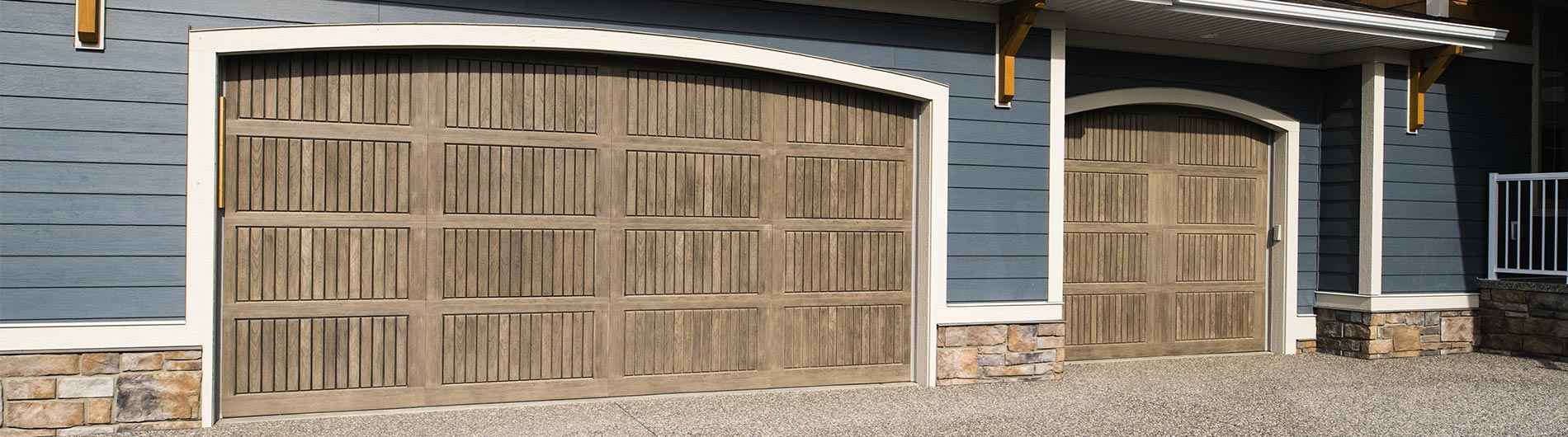
Fiberglass is known for its ability to mimic wood, without the price tag or maintenance. It can easily replicate the colors and grain patterns of real wood garage doors. Fiberglass is generally a low maintenance material, but it’s not as easy to repair damage made to the fiberglass sections as it is to repair other materials.
A lighter material than steel or wood, it doesn’t require a high power opener, which means it won’t put too much strain on the spring system. The construction of this material is simply two sheets of fiberglass surrounding a steel frame which is then insulated. Fiberglass itself is a poor insulator, so you’d probably want to opt for insulation if you choose this type of material.
It is very resistant to insects, warping, dents, moisture, and changes in humidity, which make this garage door material a great choice for homes on the coast or in salty environments. While this material is able to withstand many weather and climate conditions, the sun can cause the fiberglass to fade and become discolored, even turn yellow, and it is often less durable in cold climates.
Pros
- Replicates other materials: Fiberglass can easily be made to look like wood or other materials so homeowners can get the design they want without spending too much.
- Highly rust resistant: Aluminum is rust resistant, which allows this garage door material to be long lasting.
- Good for coastal environments: Fiberglass is a good choice for homeowners who live in beachy or salty environments.
- Value efficient: Fiberglass garage doors are affordable and generally worth their while.
- Low maintenance: While fiberglass is a low maintenance material, it is not easy to repair.
Cons
- Less durable in cold climates: Fiberglass is a generally durable material, but has been known to not hold up as well in cold climates.
- Poor insulator: Fiberglass itself is a poor insulator.
- Fades in the Sun: Fiberglass garage doors can fade in the sun and start to take on a yellow tinge as they age.
- Limited customization: Fiberglass garage doors have limited customization options and are usually offered in common designs and styles.
Aluminum
Aluminum garage doors share many of the characteristics of steel. It can be made to mimic wood in color and texture, just like steel. But because it looks and acts like steel, doesn’t mean it’s the same. Because aluminum doesn’t rust, it’s a better material for coastal environments, although vinyl is the best solution for that area.
Pros
- Rust resistant: Aluminum is not susceptible to rust, so it is a great material for many climates, especially coastal areas.
- Easier to recycle: Aluminum is an easy material to recycle, so it’s eco friendly.
Cons
- Dents easily: Aluminum can dent easily, so it’s not ideal for a rough and tough lifestyle.
Glass
As garage doors become more of a focal point of a home's exterior, they are inherently becoming more modern to suit the exterior architecture. Glass is a very contemporary material for garage doors. It offers sleek, clean lines that are second to none. Compared to a steel or aluminum door, glass doors can get pretty expensive, but the wow factor that they offer is worth it to some homeowners.
When considering a glass garage door, you have to think about the function of your garage as a whole. If you use your garage door to house your expensive cars, then glass may be a good option for you. But if you practice woodworking in your garage or have a brood of kids around the house, glass won’t be a good choice.

Pros
- Aesthetically pleasing: This material gives the appearance of wealth and modernity. The sleek exterior of a glass garage door offers real curb appeal.
Cons
- Not very durable: Glass is a pretty delicate material, so if your garage door has a higher chance of getting damaged or broken.
- Costly repairs: Replacing glass sections can get expensive.
- Functionality: This door isn’t a great choice if you’re looking to have a garage door that can take some bumps and bruises.
Wood Composite
There has been a recent increase in composite materials, mainly for wood and vinyl. Wood composites, most popular are Extira and Tricoya, offer many of the same qualities as real wood, without the headache. These materials are lower maintenance but can be routed, milled, machined, painted or stained to look like real wood garage doors. They can be customized just as cedar or sapele mahogany could be.
Wood composites like Tricoya and Extira pride themselves on being “made to use outside” while other materials such as wood or steel aren't truly as sturdy or durable. A combination of resin and wood fillers, wood composite doors are moisture resistant, so you don't have to worry about cracking, warping, or termite damage. Extira wood composite is said to be 90% wood, so it handles much like the natural material. Speaking of natural materials, both Extira and Tricoya wood composites are sustainable and made using reclaimed wood or wood that is the byproduct of other operations.
Pros
- Good for southern exposure: Wood composite doors can absorb heat better than wood doors without the fading that occurs on the finish.
- Moisture resistant: The material is moisture resistant which leads to less warping and cracking.
- Lower maintenance than wood: Real wood garage doors require regular refinishing, but wood composite materials don’t require the same amount of maintenance.
- Durable: This material is long lasting and is resistant to cracking, moisture, and termite damage. It also has reduced swelling and shrinking.
- Customization: Wood composites can be routed, carved, and machined to your specifications so you can create a true custom door.
- Sustainable material: For those interested in going green, wood composite materials are sustainably made.
Cons
- Use of formaldehyde: While some wood composites have added formaldehyde to their material, Tricoya and Extira do not.
- More expensive than standard steel door: Wood composite materials are cheaper than mahogany wood but more expensive than most other materials.
Vinyl Composite
Vinyl composites are a cellular PVC material that is long lasting and durable, not to mention, completely customizable! This material can be routed, milled, cut and shaped to meet your design needs like wood, without the maintenance. The opportunity to customize doors, from the classic carriage house style to a completely unique design is what makes vinyl composite so versatile and mainstream. Vinyl composite garage doors are low maintenance because of their resistance to rot, moisture and warping. A wipe down a few times a year would help keep this door running smooth and looking great. Homeowners can have a white door, have it painted, or even opt for a wood stain look that truly mimics the look of real wood, without the work. While it’s suggested that vinyl composite doors are not painted dark colors because they can absorb heat quickly, there are many other finishing options for this material.